Why Chain Pre-Stretching Matters: The Process Behind Longer Chain Life
- Why do some roller chains last for years while identical-looking chains from other suppliers stretch out of spec within months?
- The answer often lies in a production step you never see on a spec sheet: pre-stretching.
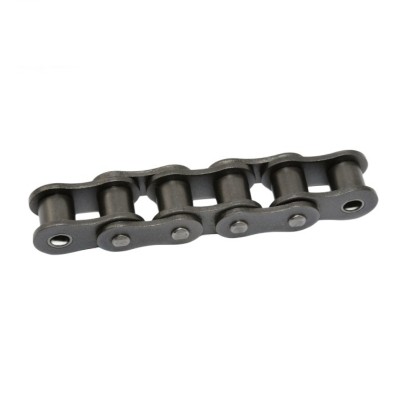
Pre-stretching is the factory process of loading a finished chain under controlled tension to seat its pins, bushings, and plates before it leaves the workshop.
What Is Chain Pre-Stretching?
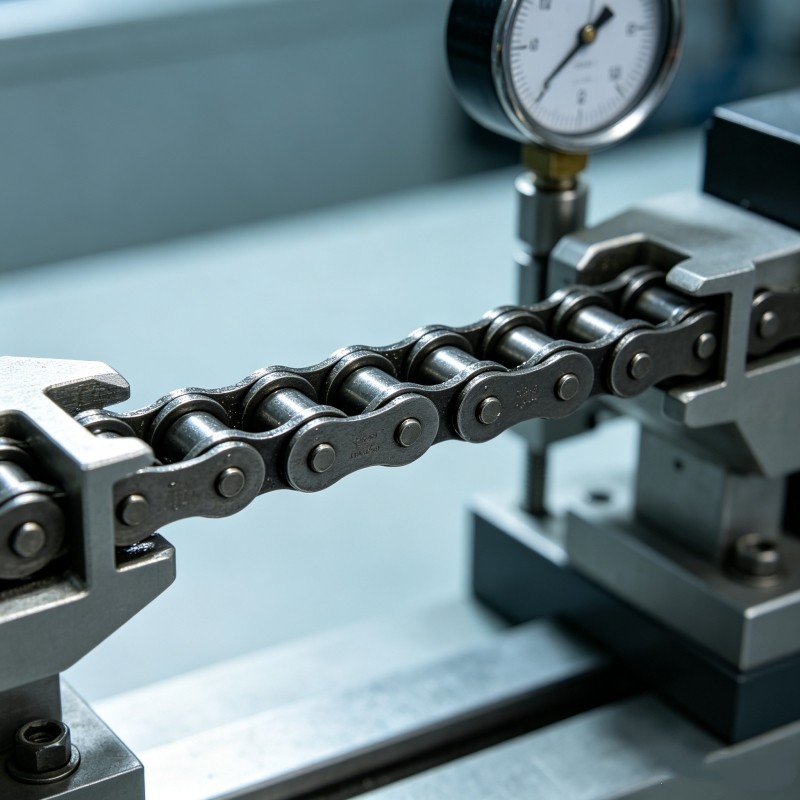
Pre-stretching is a mechanical treatment applied to a completed roller chain before packaging. The chain is pulled under a carefully controlled tensile load for a short period so that all components settle into their final working positions. During this process, the initial clearance between pins, bushings, and link plates is taken out under load, and the chain achieves dimensional stability that it would otherwise reach only after hours of running in the customer's machine.
In a typical process, the chain is loaded to a fraction of its minimum ultimate tensile strength, held for a defined dwell time, and sometimes cycled more than once. After stretching, the factory measures the pitch of individual links to confirm uniformity. Only chains that hold consistent pitch after pre-stretching are released for shipment.
Why Pre-Stretching Directly Affects Chain Life
Every roller chain has a small amount of built-in clearance between its moving parts. When a new chain is first put under load, these clearances close and the chain "beds in." Without pre-stretching, that bedding-in happens on your machine, in your production line, during your first shifts. The results are predictable: the chain loosens quickly, the tensioner has to be adjusted again and again, and the drive starts to vibrate while the chain and sprockets wear against each other.
Pre-stretched roller chain, by contrast, arrives already settled. The initial elongation has been removed in the factory, so the chain keeps its tension longer, wears more evenly, and delivers a noticeably longer service life. For high-speed or high-load drives, this difference can be the margin between a reliable season and a mid-production breakdown.
The Pre-Stretching Process in a Real Factory
How a manufacturer performs pre-stretching reveals its engineering level. A serious factory controls three things: load, time, and measurement.
Controlled Tensile Load
The chain is pulled to a predetermined load, typically around one-third of its minimum ultimate tensile strength, chosen so that all joints seat fully without damaging the material. The load is applied gradually and held for a defined dwell time so that the clearance is removed consistently across every link. Load control matters: too little tension leaves the chain unseated, and too much can overstress the plates and shorten fatigue life.
Uniform Application and Repeat Cycles
Professional manufacturers apply the load uniformly along the whole strand and may repeat the cycle to stabilize the chain. The equipment applies and releases the load smoothly, avoiding shock loading that would locally deform components. After each cycle, the operator checks that the chain returns to a straight, consistent geometry.
Pitch Measurement and Inspection
After pre-stretching, the factory measures the pitch of multiple links and verifies that they are uniform within tolerance. This measurement is the real proof of the process: a well-stretched chain shows consistent pitch across its entire length. The inspection results are recorded and kept traceable to the production batch, so every shipment can be traced back to its process parameters.
Pre-Stretching vs. In-Service Elongation
It is important to distinguish the two types of chain elongation. Pre-stretching removes the initial, non-wear elongation caused by component clearances settling.
In-service elongation over time is caused by wear at the pin-bushing interface, and no factory process can eliminate it.
What pre-stretching does is give you the full usable wear life of the chain: because the initial slack is already removed, the chain starts from a tight, stable condition, and the entire elongation budget is spent on real wear rather than bedding in.
What Happens Without Pre-Stretching
Rapid initial loosening. The chain stretches visibly in the first days of operation and needs repeated re-tensioning.
Vibration and noise. Loose chain slaps the sprockets, increasing shock loads on shafts and bearings.
Uneven wear. Load concentrates on a few links instead of distributing evenly, accelerating localized wear.
Chain jumping and downtime. In severe cases, the chain skips teeth, stopping the machine at the worst possible moment.
Frequently Asked Questions
Does pre-stretching reduce chain strength?
No. When performed correctly at the proper load, pre-stretching seats the joints without damaging the material. It does not reduce the chain's ultimate tensile strength or fatigue performance; it removes initial clearance that would otherwise cause early loosening.
Does pre-stretching replace the need for a tensioner?
No. Even a pre-stretched chain elongates over time due to normal wear. A properly designed drive still needs correct initial tension and periodic adjustment; pre-stretching simply means you start from a stable, tight condition.
Choose a Manufacturer, Not Just a Price
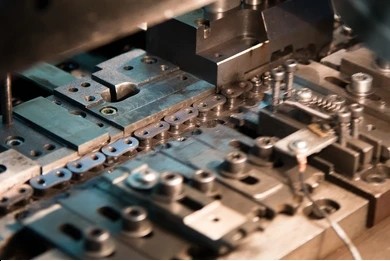
Pre-stretching is one of those invisible quality steps that separates real chain factories from resellers. When you source roller chain, ask about the process: how the chain is pre-stretched, how it is inspected, and how the process is controlled.
Our factory performs controlled pre-stretching with pitch verification on every production batch, and we are happy to walk you through our process and share inspection data. Browse our ANSI #40 roller chain and stainless steel roller chains, or read our guide on how to size roller chains for your application.