Simplex vs Duplex vs Triplex Roller Chain: Load Chart | CTS
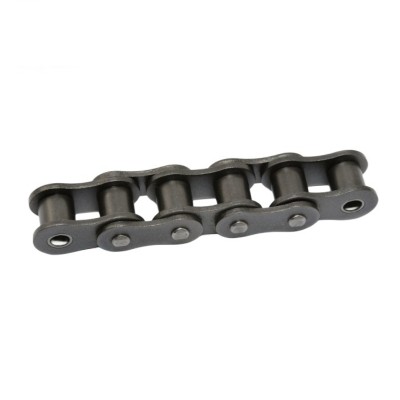
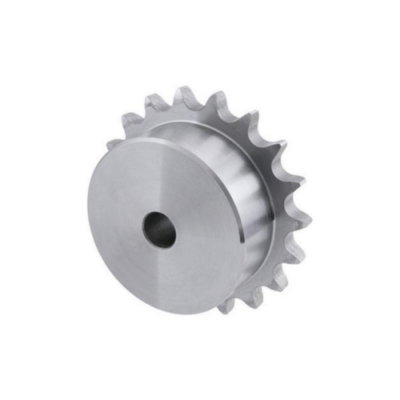
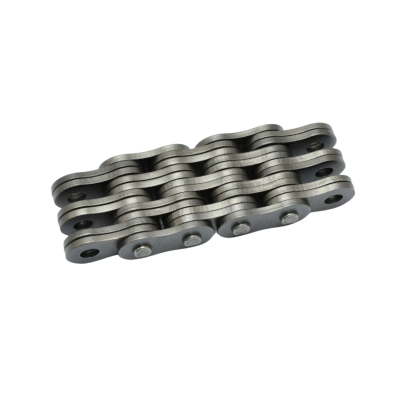
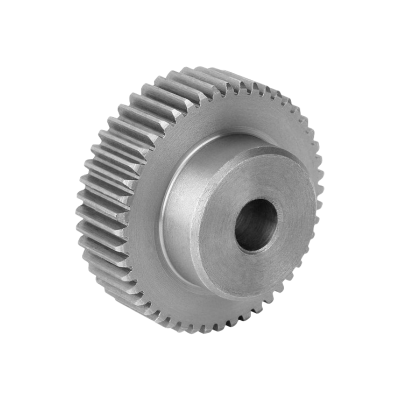
A triplex roller chain is three simplex chains assembled on common pins. Same pitch, same roller, same plate thickness — roughly three times the tensile strength of the single-strand chain, and about three times the wear life at the same pull. What it is not is a drop-in swap: the sprocket, the transverse pitch and the shaft width all have to change with the strand count. The load data and the matching rules are below. All three share a chain number, so pitch, roller diameter, inner width and plate thickness are identical. The only difference is how many plate stacks sit on each pin. A simplex chain has one row of inner plates between two outer plates, a duplex chain has two rows with a shared centre plate, and a triplex chain has three. The tooth form doesn't change, which is why a #80 simplex sprocket and a #80 triplex sprocket have the same tooth profile—and why they still cannot be used interchangeably. The ISO naming runs the same way: ANSI #80 is ISO 16B, and the -1 / -2 / -3 suffix counts strands in both systems. Compare pin diameter and inner width before trusting a cross-reference, because the two standards are close but not identical at every size. The table is our catalogue minimum ultimate tensile, the figure that goes on the test report. Because every strand rides on the same pins and uses the same plates, the value scales almost exactly with strand count: duplex sits at 2.0 times the simplex figure and triplex at 3.0 times. The ratio holds across the range because plate thickness and pin diameter do not change with strand count; only the pins get longer. #41 is the exception worth knowing: it is catalogued as simplex and duplex but not as a standard triplex, so a request for 41-3 normally means a move to #40-3 or a different pitch. Ultimate tensile is a breaking figure, not a working load. Drive selection usually runs a factor of roughly 6 to 8 against it for smooth duties, and higher where there is shock, reversing, or frequent starting — confirm the figure the applicable standard or the machine builder requires rather than assuming it. The trap is that 3.0 times is arithmetic, not field performance. Three strands share the load evenly only when both sprockets are aligned, unworn, and cut to the same transverse pitch. A hooked sprocket or half a degree of shaft misalignment loads one strand harder than the other two, and the chain breaks at the load you thought you had margin on. Until the alignment and tooth wear are verified, treat triplex as something below its catalogue 3.0 times. One thing does not change with strand count: the pull on the shaft. Chain pull works out as twice the torque divided by pitch diameter, so at the same sprocket and the same torque, a triplex chain pulls exactly as hard as a simplex chain. What triplex changes is the stress inside each plate and each pin, and the wear life at a given load. It does not reduce the radial load your bearings see. If anything, the heavier chain and the wider hub make the shaft and bearing check more important, not less. A multi-strand sprocket is a single part with several rows of teeth. It is not three simplex sprockets bolted together and it cannot be assembled from them, because each tooth row is narrower than a simplex sprocket and the spacing between rows is fixed by the chain standard. These are the numbers to match against. Four cases where a third strand is the wrong answer. If the failure is abrasive wear, hardening, sealing or lubrication does more than another row of plates. If the failure is shock or reversing load, a larger pitch or a damper does more. If the shaft is already full, a duplex one size larger is usually cheaper than a triplex at the same pitch. If you want redundancy, two duplex drives beat one triplex, because a single triplex chain still fails as one unit. We build ANSI simplex, duplex and triplex roller chain from #35 to #240, the ISO 05B to 72B range, and the ANSI sprockets to match them. The three chain families are listed separately: simplex, duplex and triplex roller chain, all to ANSI B29.1 and interchangeable with other certified chains of the same number. If you are replacing an existing triplex drive, send the chain number stamped on the plates, the pitch count and the tooth counts on both sprockets. If the chain is unmarked, send pitch, roller diameter, pin diameter and pin length across the outer plates — pin length is what separates a -2 from a -3 once the plates have worn and the markings are gone. The full dimension set for every number is in our roller chain size chart, and the tooth and wear rules are in the chain and sprocket matching guide. We confirm strand count against the sprocket before quoting, because that is the mismatch that shows up most often: a triplex chain ordered for a duplex sprocket, or a stock sprocket whose transverse pitch does not match the chain. Documents on request: dimensional inspection report, tensile test report, and material certificate.Simplex, duplex and triplex chain: what actually changes
Item
Simplex
Duplex
Triplex
Strands
1
2
3
ISO Chain equivalent at 1 in pitch
16B-1
16B-2
16B-3
Plate stacks per pin
2
4
6
Ultimate tensile, #80
56.7 kN
113.4 kN
170.1 kN
Pin length, #80
32.70 mm
62.7 mm
91.7 mm
Transverse pitch, #80
not applicable
29.29 mm
29.29 mm
Load capacity: the numbers, and the trap behind them
Chain no.
Simplex (kN)
Duplex (kN)
Triplex (kN)
Triplex ÷ simplex
40
14.10
28.20
42.3
3.0×
50
22.20
44.40
66.6
3.0×
60
31.80
63.60
95.4
3.0×
80
56.70
113.40
170.1
3.0×
100
88.50
177.00
265.5
3.0×
120
127.00
254.00
381.0
3.0×
140
172.40
344.80
517.2
3.0×
160
226.80
453.60
680.4
3.0×

Sprocket matching: four dimensions that have to agree
Chain no.
Transverse pitch Pt (mm)
Pin length simplex (mm)
Pin length duplex (mm)
Pin length triplex (mm)
Width added by triplex (mm)
40
14.38
16.60
31.0
45.4
+28.8
50
18.11
20.70
38.8
56.9
+36.2
60
22.78
25.90
48.7
71.5
+45.6
80
29.29
32.70
62.7
91.7
+59.0
100
35.76
40.40
76.4
112.2
+71.8
120
45.44
50.30
95.8
141.4
+91.1
140
48.87
54.40
103.3
152.2
+97.8
160
58.55
64.80
123.3
181.8
+117.0
What a triplex drive needs that a simplex drive does not
What CTS supplies