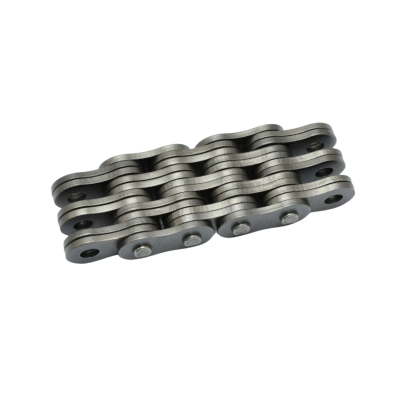
Leaf Chain Size Chart: BL Series Pitch, Lacing and Dimensions
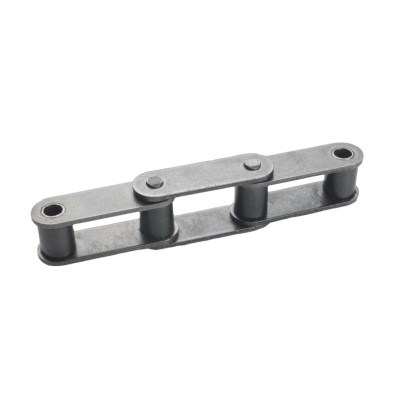
A leaf chain with no tag can still be identified. Two numbers decide everything: pitch and lacing. This chart covers all 63 BL models we build, from BL422 to BL2088, shows how the part number encodes both values, and explains how to measure an unmarked mast or lift chain so the replacement arrives correct the first time.
What a BL part number tells you
BL is the heavy-duty leaf chain series under ANSI. The ISO name for the same construction is LH, and the two are normally interchangeable in dimensions, but compare datasheets rather than labels before you commit.
The code after BL is three or four digits with two meanings: the leading digit or digits are the pitch code in units of 1/8 inch, and the last two digits are the lacing, written outer plates × inner plates.
| Part number | Pitch | Lacing | What it means |
|---|---|---|---|
| BL434 | 4/8 = 1/2 in (12.70 mm) | 3 × 4 | Light-duty 1/2 in chain, mid lacing |
| BL888 | 8/8 = 1 in (25.40 mm) | 8 × 8 | Full-lacing 1 in chain, highest strength in its pitch |
| BL1088 | 10/8 = 1-1/4 in (31.75 mm) | 8 × 8 | Heavy 1-1/4 in chain for large lift trucks |
The same coding rule applies to the AL light-duty series, which uses thinner plates. The LL and EL series switches to 1/16 inch units, and that is the single most common cross-reference mistake: LL1644 is 16/16 = 1 in pitch, not 2 in.
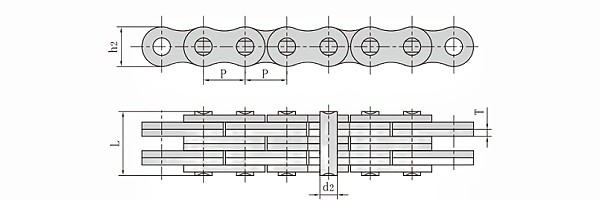
BL series size chart
All 63 models, grouped by pitch. Lacing is written outer × inner. The strength column ranks models within the same pitch only; a BL466 is not stronger than a BL622, because the pitch has changed.
| Model | Pitch (in) | Pitch (mm) | Lacing (outer × inner) | Relative tensile, same pitch |
|---|---|---|---|---|
| BL422 | 1/2 | 12.70 | 2 × 2 | Lightest |
| BL423 | 1/2 | 12.70 | 2 × 3 | Light |
| BL434 | 1/2 | 12.70 | 3 × 4 | Medium |
| BL444 | 1/2 | 12.70 | 4 × 4 | Medium-high |
| BL446 | 1/2 | 12.70 | 4 × 6 | High |
| BL466 | 1/2 | 12.70 | 6 × 6 | Very high |
| BL488 | 1/2 | 12.70 | 8 × 8 | Highest |
| BL522 | 5/8 | 15.88 | 2 × 2 | Lightest |
| BL523 | 5/8 | 15.88 | 2 × 3 | Light |
| BL534 | 5/8 | 15.88 | 3 × 4 | Medium |
| BL544 | 5/8 | 15.88 | 4 × 4 | Medium-high |
| BL546 | 5/8 | 15.88 | 4 × 6 | High |
| BL566 | 5/8 | 15.88 | 6 × 6 | Very high |
| BL588 | 5/8 | 15.88 | 8 × 8 | Highest |
| BL622 | 3/4 | 19.05 | 2 × 2 | Lightest |
| BL623 | 3/4 | 19.05 | 2 × 3 | Light |
| BL634 | 3/4 | 19.05 | 3 × 4 | Medium |
| BL644 | 3/4 | 19.05 | 4 × 4 | Medium-high |
| BL646 | 3/4 | 19.05 | 4 × 6 | High |
| BL666 | 3/4 | 19.05 | 6 × 6 | Very high |
| BL688 | 3/4 | 19.05 | 8 × 8 | Highest |
| BL822 | 1 | 25.40 | 2 × 2 | Lightest |
| BL823 | 1 | 25.40 | 2 × 3 | Light |
| BL834 | 1 | 25.40 | 3 × 4 | Medium |
| BL844 | 1 | 25.40 | 4 × 4 | Medium-high |
| BL846 | 1 | 25.40 | 4 × 6 | High |
| BL866 | 1 | 25.40 | 6 × 6 | Very high |
| BL888 | 1 | 25.40 | 8 × 8 | Highest |
| BL1022 | 1-1/4 | 31.75 | 2 × 2 | Lightest |
| BL1023 | 1-1/4 | 31.75 | 2 × 3 | Light |
| BL1034 | 1-1/4 | 31.75 | 3 × 4 | Medium |
| BL1044 | 1-1/4 | 31.75 | 4 × 4 | Medium-high |
| BL1046 | 1-1/4 | 31.75 | 4 × 6 | High |
| BL1066 | 1-1/4 | 31.75 | 6 × 6 | Very high |
| BL1088 | 1-1/4 | 31.75 | 8 × 8 | Highest |
| BL1222 | 1-1/2 | 38.10 | 2 × 2 | Lightest |
| BL1223 | 1-1/2 | 38.10 | 2 × 3 | Light |
| BL1234 | 1-1/2 | 38.10 | 3 × 4 | Medium |
| BL1244 | 1-1/2 | 38.10 | 4 × 4 | Medium-high |
| BL1246 | 1-1/2 | 38.10 | 4 × 6 | High |
| BL1266 | 1-1/2 | 38.10 | 6 × 6 | Very high |
| BL1288 | 1-1/2 | 38.10 | 8 × 8 | Highest |
| BL1422 | 1-3/4 | 44.45 | 2 × 2 | Lightest |
| BL1423 | 1-3/4 | 44.45 | 2 × 3 | Light |
| BL1434 | 1-3/4 | 44.45 | 3 × 4 | Medium |
| BL1444 | 1-3/4 | 44.45 | 4 × 4 | Medium-high |
| BL1446 | 1-3/4 | 44.45 | 4 × 6 | High |
| BL1466 | 1-3/4 | 44.45 | 6 × 6 | Very high |
| BL1488 | 1-3/4 | 44.45 | 8 × 8 | Highest |
| BL1622 | 2 | 50.80 | 2 × 2 | Lightest |
| BL1623 | 2 | 50.80 | 2 × 3 | Light |
| BL1634 | 2 | 50.80 | 3 × 4 | Medium |
| BL1644 | 2 | 50.80 | 4 × 4 | Medium-high |
| BL1646 | 2 | 50.80 | 4 × 6 | High |
| BL1666 | 2 | 50.80 | 6 × 6 | Very high |
| BL1688 | 2 | 50.80 | 8 × 8 | Highest |
| BL2022 | 2-1/2 | 63.50 | 2 × 2 | Lightest |
| BL2023 | 2-1/2 | 63.50 | 2 × 3 | Light |
| BL2034 | 2-1/2 | 63.50 | 3 × 4 | Medium |
| BL2044 | 2-1/2 | 63.50 | 4 × 4 | Medium-high |
| BL2046 | 2-1/2 | 63.50 | 4 × 6 | High |
| BL2066 | 2-1/2 | 63.50 | 6 × 6 | Very high |
| BL2088 | 2-1/2 | 63.50 | 8 × 8 | Highest |
Absolute tensile values depend on plate material, pin diameter and heat treatment, and they differ between manufacturers at the same model number. Ask for the test report instead of comparing catalogue figures across brands.
Pitch versus lacing: what you can and cannot change
- Pitch cannot change. Pitch is set by the sheave and the anchor geometry. A 5/8 in chain will not run on a 3/4 in sheave.
- Lacing can sometimes be upgraded, and this is where the value sits. Moving from 3 × 4 to 4 × 6 in the same pitch raises tensile and bearing area without touching the sheaves, but it widens the chain and lengthens the pins. Check anchor pin length, clevis width and clearance to the mast channel before assuming it fits.
- Never mix lacing within a pair. Mast chains work as a matched pair; unequal lacing loads one side and shows up later as a bent pin or a cracked plate.
When two models share a catalogue tensile, choose the one with the larger bearing area: pin diameter × plate thickness × plate count. That is the difference between a chain that wears for years and one that frets its plate holes in a season.
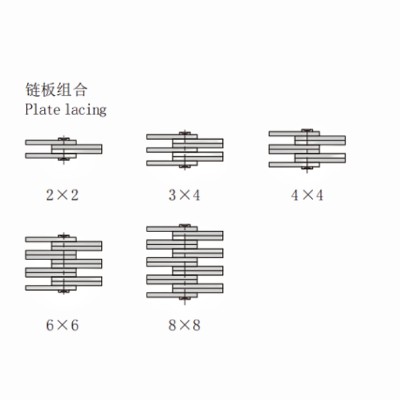
How to measure an unmarked leaf chain
- Pitch. Measure centre to centre of pins across five pitches and divide by five. Do not measure a single pitch on a worn chain, because pin and hole wear bias the result.
- Pin diameter. Caliper across the pin itself, not across the plate.
- Plate thickness. Measure an outer plate and an inner plate separately; they are often different.
- Width over pins. Across the outside faces of the outer plates.
- Lacing. Count plates in each row across one pin. You will see alternating rows, for example three plates then four, which is 3 × 4.
Match the four dimensions against the chart. When two models look close, pin diameter and plate thickness separate them.
Wear limits and when to replace
Leaf chain does not stretch the way a roller chain does, because there are no bushings to wear through. The plate holes and pins wear instead, and elongation creeps up slowly until it accelerates.
| Check | Method | Replace when |
|---|---|---|
| Elongation | Measure over 5 or more pitches and compare with nominal | 1.5 to 2% over nominal, or the stricter OEM figure |
| Plate hole wear | Look for pin witness marks, ovality and fretting debris | Visible ovality or fretting at any hole |
| Pin condition | Check for rotation marks and corrosion pitting | Pitting on the load-bearing pin surface |
| Plate cracks | Inspect around pin holes, especially outer plates | Any crack, remove from service immediately |
| Sheave wear | Check groove profile and running diameter | Worn sheave, which will destroy a new chain quickly |
Three rules from field work. Replace mast chains as a matched pair, because one new chain beside a worn one runs at a different length and takes more load. Replace the sheave when the chain is badly worn, or the new chain fails early and the chain gets blamed. Re-check tension after the first shifts, and adjust both sides equally.
Matching a leaf chain to a lift application
Leaf chain runs over sheaves, so it does not have the chordal action of a roller chain drive, and the selection logic is different.
- Size on ultimate tensile with a safety factor, not on working load. Lifting equipment commonly uses 5:1 or higher; confirm the figure required by the applicable standard and by the truck manufacturer.
- Confirm the end fittings: clevis, anchor pin, adjusting nut and the number of pitches between them.
- Specify length in pitches, not in metres. Pitch count is what the factory and the anchor geometry both work in.
- For washdown, marine or outdoor masts, specify plated or coated pins and plates. Corrosion pitting is the leading cause of unexpected leaf chain failure in those environments.
Where this fits with our other leaf chain guides
This page is the size and measurement reference. For the naming system across AL, BL/LH and LL/EL, read leaf chain numbering explained. For the light-duty alternative and where it belongs, see BL versus AL leaf chain.
What CTS supplies
We build the full BL leaf chain range from BL422 to BL2088, plus the matching AL series, cut to the pitch count you specify with clevis or pin ends. Documents available on request: material certificate, dimensional inspection report and tensile test report.
If you are replacing a chain with no markings, send four numbers, which are pitch, pin diameter, plate thickness and lacing, and we will confirm the model against the chart above before quoting.
Next step
If you already know the model, send the part number plus the length in pitches. If you do not, measure pitch, pin diameter, plate thickness and lacing, then send those four figures with a photo of the chain on the machine.
We will come back with the model, the lacing options available in that pitch, and the lead time. No catalogue guessing, and no substitution without your approval.