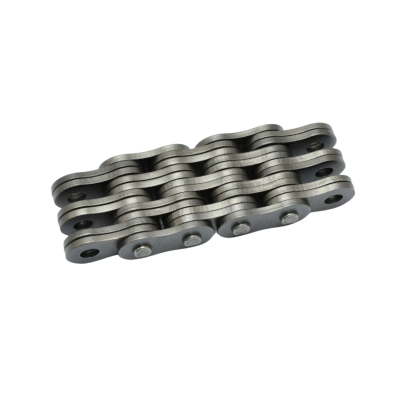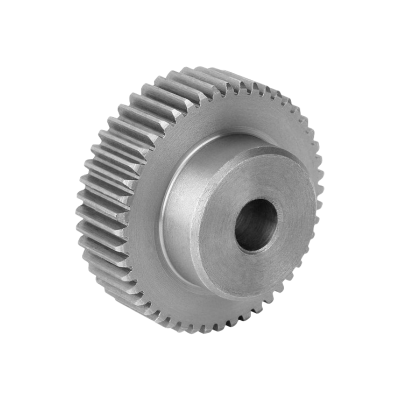
Conveyor Chain Types: Roller, Double Pitch, Hollow Pin, Attachment
Conveyor chains are the workhorses behind almost every production floor on the planet. Whether you are moving pallets through an automotive assembly line, totes through a warehouse sortation system, baked goods through an oven, or bottles through a filling line, the chain doing the pulling is almost always a variant of the classic roller chain.
Yet "conveyor chain" is not a single product. The same basic anatomy — inner plates, outer plates, pins, bushings, and rollers — can be reconfigured in four fundamentally different ways, and each variant is optimized for a different set of speed, load, layout, and fixture requirements.
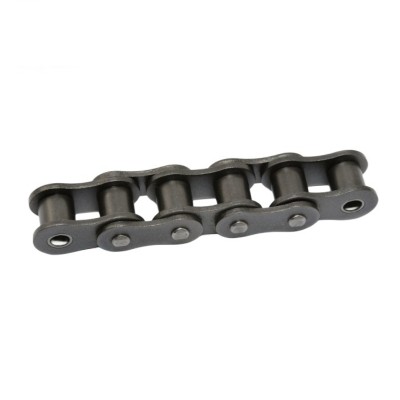
Standard Roller Conveyor Chain

A standard roller conveyor chain follows the classic ANSI short-pitch roller chains used in power transmission: alternating inner and outer link plates, press-fit bushings in the inner plates, rollers that freely rotate on those bushings, and pins that articulate the inner and outer links together. Sizes run from #25 (6.35 mm pitch) up to #240 (76.2 mm pitch), with single-strand, duplex, and triplex versions available.
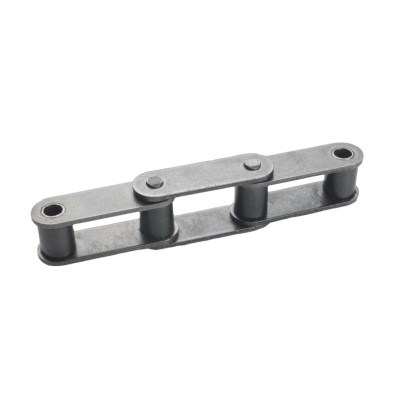
Double Pitch Conveyor Chain

Double pitch conveyor chain — the ANSI C2000 series (C2040, C2042, C2050, C2052, C2060H, C2080H, and so on) — is derived from a standard short-pitch roller chain by doubling the pitch while keeping the pin diameter, bushing, and plate dimensions matched to the base chain number. A C2050, for example, uses the same pin and plate cross-section as an 80 roller chain, but at 25.4 mm pitch rather than 12.7 mm.
Conveyor Chain Attachment Types
There are four common versions: without rollers, with S small rollers, with P large rollers and with F flanged rollers.

without rollers
No rollers. The bushings run directly on the rail or the support.

with S small rollers
Rollers the same diameter as the base chain of that number (2040-S: 7.95 mm, the #40 roller).

with P large rollers
Oversized rollers on the same pitch and pins.

with F flanged rollers
Rollers with a raised flange on the side.
Hollow Pin Conveyor Chain

Hollow pin chain looks like a standard roller chain at first glance, but every pin is replaced by a fully bored hollow pin running through the outer plates. The bore is sized to accept a cross rod, spindle, bolt, or fixture shaft directly through the chain, with no drilling, tapping, or welding of chain plates required.
Hollow pin versions exist in both carbon steel (black oxide or zinc-plated) and 304 / 316 stainless steel. The stainless versions are the workhorse of food, beverage, and pharmaceutical environments because they are washdown-safe, resistant to chlorinated cleaning chemicals, and easy to clean.
Attachment Conveyor Chain
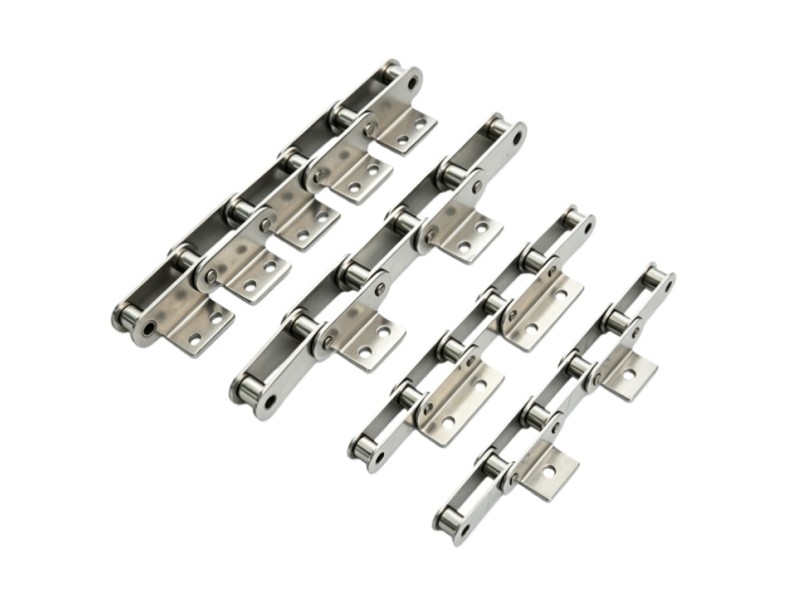
An attachment chain is any base chain — short pitch or double pitch — fitted with extended link plates, bent tabs, extended pins, or custom mounting lugs at regular intervals. The attachment interval is specified in pitches: every 3 pitches, every 5 pitches, every 10 pitches, etc.
• A1— Bent tab, one side, one hole. Mounts outside the chain line for light side-mounted pushers and locating fixtures.
• A2 — Bent tab, one side, two holes. A wider version of A1: the second bolt spreads the load and stops the bracket rotating about a single hole, so it takes wider brackets.
• K1 — Platform, both sides, one hole each. The mounting face is parallel to the chain line and to the pin axis, giving a flat surface above the chain — the usual choice for slats, scrapers and buckets.
• K2 — Platform, both sides, two holes each. A wider, heavier platform with better twist resistance; used for wide slats, paired flights, and heavier top-mounted tooling.
• D1 — Extended pin, one side, no tab. Not a mounting face but a shaft: for hangers, pivots and guides, or for a part that turns on the pin.
• D3 — Extended pins on both sides. For cross bars, paired hangers, and double-sided linkages that load the pin from both sides.
Conveyor Chain Choosing in Six Questions
1. How is the product supported?
On the rollers, use standard or double pitch. Between two strands, use hollow pin. In buckets or between flights, use attachment chain.
2. How long is the conveyor?
Long runs and moderate speeds favour double pitch: fewer joints, less weight, less to replace.
3. Does the product accumulate?
Sliding accumulation needs low-friction chain or roller-top; hanging or wide loads point to hollow pin with cross rods.
4. What is the load per roller?
Size from load per roller or per metre first, then check tensile. Double pitch and hollow pin ratings do not follow the standard chain.
5. What is the environment?
Washdown and food areas need stainless or nickel plating; dust and grit need larger rollers and a dry lubrication schedule.
6. How will it be maintained?
If the line has to be opened in the field, specify cottered pins or connecting links that can be worked with hand tools.
What CTS supplies
We build the four families covered here, plus the heavier engineering conveyor chains that take over where roller chain stops:
✔ Standard roller chain — ANSI #35 to #240 and ISO 05B to 72B, single, duplex, and triple strand, stainless and plated.
✔ Double pitch — ANSI 2040 to 2120 and metric 208B to 232B, with standard or large (H) rollers and A1/A2/K1/K2 attachments.
✔ Hollow pin — ANSI 40HP to 80HP, with stainless and plated options; larger sizes and special pins to order.
✔ Attachment chain — A1, A2, K1 and K2 in ANSI and metric, with standard or custom spacing; special tabs to drawing.
✔ Engineering conveyor chain — FV and FVT series, M series, 81X lumber chain, drop forged rivetless X-type and WR/WH mill chains.
If you are replacing a chain, send the chain number from the plate, the pitch, the attachment spacing, and a photo of the conveyor at the transfer point. Those four items determine the type, the strength, and the sprocket in one exchange: Send A Conveyor Chain Enquiry.